
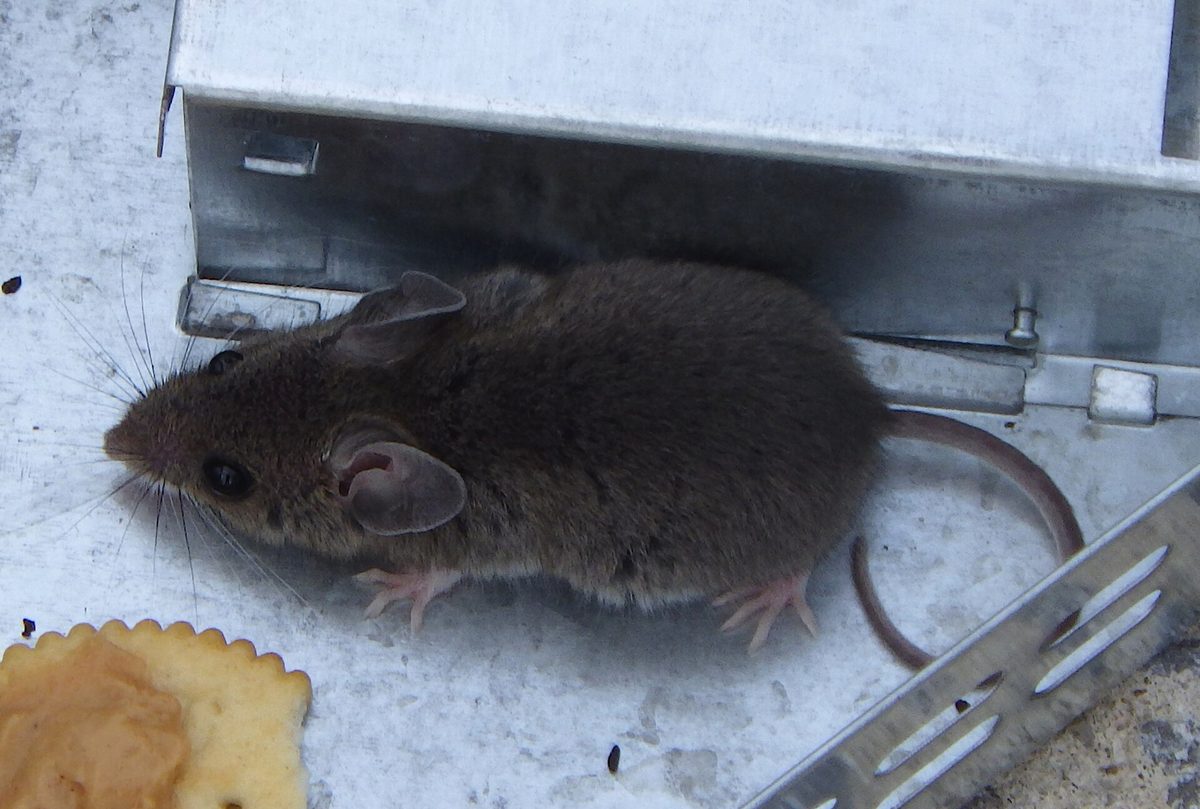
The fastest way to get rid of mice is a combination of traps and exclusion: set snap traps or humane live traps along the walls where mice travel, remove their food sources, and seal every gap wider than a pencil — because mice squeeze through holes the size of a dime. Humane removal works, but only if you seal the entry points; otherwise new mice replace the ones you catch within weeks.
Confirm you have mice (droppings, gnaw marks, night scratching) → set traps along walls, not in open floor → secure all food → find and seal entry gaps → keep traps out for a week after the last catch → get a pro if activity continues past two weeks.
How to Tell If You Actually Have Mice
Mice are quieter than you think. By the time you see one in daylight, there are usually more.
The signs to check:
- Droppings. Dark pellets, 3–6 mm, shaped like grains of rice with pointed ends. Check under the sink, behind the stove and fridge, inside the pantry, and along baseboards. Fresh droppings are dark and soft; old ones are grey and crumble.
- Gnaw marks. Mice gnaw constantly. Look for rough-edged holes in cardboard, plastic bins, and the corner of dry goods packaging. Rub marks along baseboards come from the oils in their fur.
- Sounds. Scratching or skittering inside walls, above ceilings, or under floors at night. A mouse sounds small and quick — a rat sounds heavier, like something dragging.
- Nests. Shredded paper, insulation, or fabric tucked into a quiet spot: the back of a drawer, a storage box, the corner of the furnace room.
A cat staring at a wall for an hour is not a confirmation. Find droppings or gnawing first.
Step 1: Seal Entry Points (the Step Most People Skip)
You can trap mice forever and never win if the door stays open. Mice enter low — at ground level or below — and Saskatoon homes give them plenty of options: the gap where the siding meets the foundation, dryer vents, the hole where the gas line or central air line enters, gaps under garage doors, and weep holes in brick.
How to seal properly:
- Steel wool or copper mesh first, then caulk or expanding foam over it. Mice chew through foam alone within a day. The metal is the barrier; the foam holds it in place.
- Check the garage-to-house door seal. Attached garages are the number-one entry into Saskatoon homes — the weatherstrip at the bottom of the house door is often the weak point.
- Screen weep holes with stainless steel weep-hole covers, don’t block them — brick needs them to drain.
- Do the pencil test: anywhere a pencil fits, a mouse fits. Anything wider gets sealed.
Walk the exterior once in fall before the cold hits. An evening with a flashlight and a bag of steel wool prevents more mouse problems than a season of traps.
Step 2: Snap Traps vs. Humane Live Traps vs. Bait — What Actually Works
Snap traps. Still the fastest, cheapest, most effective homeowner tool. The modern plastic-jaw versions are easier to set and harder to misfire than the old wooden ones. The humane part is that a correct snap kill is instant — a botched glue board or poison death is not.
How to use them: set traps along walls, perpendicular, with the trigger end toward the wall. Mice hug walls when they travel and rarely cross open floor. Place them where you found droppings. Use more than you think you need — a starter population of six mice caught one-per-night is a slow week.
Bait with peanut butter pressed into the trigger, or a piece of a cotton ball (nesting material works in fall). Check traps daily. Wear gloves to dispose of catches.
Humane live traps. These work for light populations. Two rules make the difference: release mice at least a kilometre away in suitable habitat (field edge, not a parking lot — a mouse dumped in strange territory usually doesn’t last), and seal your entry points before releasing, or you’re catching the same mice’s cousins next week. Release within a few hours, especially once overnight lows approach freezing — a trapped mouse in an unheated garage dies of exposure, which defeats the purpose.
Poison bait. For homeowners, bait is the option I’d talk you out of. A poisoned mouse crawls into a wall to die and your house smells for two weeks. Dying mice are also easy prey for pets, owls, and neighbourhood cats — secondary poisoning is real. Bait belongs in tamper-proof stations in hands that monitor them, not loose under your sink. If you’re at the stage where bait seems necessary, that’s exactly the stage where a professional mouse treatment makes more sense.
Natural Deterrents That Help — and What’s a Myth
- Peppermint oil: mostly myth. Cotton balls soaked in peppermint oil may bother a mouse for a day or two in a sealed room, but it doesn’t drive an established population out, and it does nothing once the smell fades. People love this one because it’s pleasant. It is not a treatment.
- Steel wool: real. As a physical barrier, nothing beats metal a mouse can’t chew through.
- Dryer sheets: myth. Same category as peppermint.
- Cleanliness: real, but not how people think. A spotless house still gets mice — they come in for warmth and shelter in a prairie winter, not because your floor is dirty. What cleanliness does is remove the food that lets a population grow. That matters, so:
The food audit: transfer dry goods (flour, rice, cereal, pet food, bird seed) into hard plastic or glass containers with lids. Wash the dishes at night. Take the garbage out or use a sealed bin. Pick up the pet’s food bowl overnight — a bag of dog food in the mudroom feeds mice all winter.
How to Get Rid of Mice in Walls and Hard-to-Reach Spots
When the scratching is inside a wall, the rules change.
- Don’t poison mice in walls. You cannot retrieve a dead one from inside a stud bay. This is how homes get a two-week odour problem.
- Trap at the exits. Mice in walls come out at night to feed. Find where — usually a gap where a pipe passes through the wall, or under a sink cabinet — and put traps there.
- If you can open the wall (behind a removable cabinet panel, in an unfinished furnace room), set traps inside the void and check them with a flashlight.
- Attics: set traps along the attic’s edges and near the gable vents, insulation tunnels, and anywhere droppings cluster.
Noise that moves fast and is gone in a week is mice. Steady, heavy, all-night gnawing that gets louder could be squirrels — that’s a different treatment.
Keeping Mice Out Through a Saskatoon Winter
Prairie winters are the engine of the local mouse problem. Field mice that lived outdoors all summer head for warmth the first hard frost — usually late September to October in this area — and attached garages, older foundations, and acreage properties at the field edge get hit hardest. Warman, Martensville, and the acreage communities around Saskatoon see this every year.
Your fall checklist:
- Seal exterior gaps (steel wool + foam) — September, before the first frost.
- Replace worn garage and house door weatherstripping.
- Move bird seed, grass seed, and pet food into sealed bins.
- Trim back vegetation touching the house and move firewood away from the foundation — both are mouse highways.
- Set a couple of traps in the garage and furnace room as sentinels from October onward. Catching one mouse in the garage in October is a nuisance solved for a toonie. Discovering a nest in your insulation in January is a professional job.
When to Call a Pro (Signs of a Full Infestation)
Call for professional help if:
- You’re catching mice regularly for more than two weeks without activity slowing down
- Droppings show up in multiple rooms or upstairs — that suggests an established population, not a wanderer
- You hear activity inside walls you can’t access, or in the attic
- You’re finding mice in winter repeatedly despite sealing — there’s a nesting population inside somewhere
- It’s an acreage, farm, or multi-unit building with constant pressure from surrounding fields
A professional does what this guide does, but with commercial-grade trapping programs, monitoring, and the experience to find the nest and the entry points you missed. In Saskatoon, Pesto’s mouse and rat control starts with a free inspection — you’ll know what you’re dealing with before spending anything.
Still hearing scratching in the walls? Book same-day Saskatoon mouse control — call 306-715-1217.